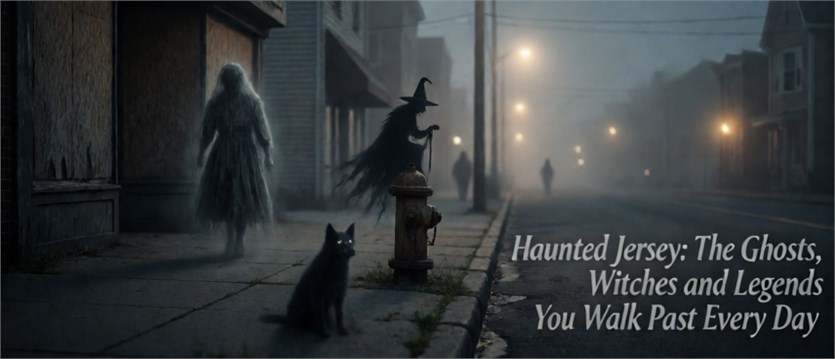
Haunted Jersey: The Ghosts, Witches and Legends You Walk Past Every Day

Published Wednesday, October 28, 2026

Generated hero article image

Haunted Jersey: The Ghosts, Witches and Legends You Walk Past Every Day

Do you believe in ghosts? I was not sure I did, until I started asking Jersey people about theirs. Everyone has a story — a lane they will not walk at night, a room that feels cold, a dog that refused to go further.

Jersey looks postcard-pretty in daylight, but after dark in late October, when the wind gets up and the lanes go black, it feels very different. We are a small island with 800 years of castles, plague, shipwrecks, Occupation tunnels and — darker than most of us realise — witch trials. How haunted is Jersey, really? I went digging through archives, castle guides and a lot of late-night conversations to find out.

We burned witches here — did you know that?

This stopped me in my tracks when I first read it. The Channel Islands have been called, by historian William Monter, "the witch-hunting capital of Atlantic Europe" for our size. Between the 1560s and the 1660s, when Jersey had only about 10,000 people, at least 65 witch trials came before the Royal Court. Thirty-three ended in execution, eight in banishment. And 88% of the accused — 57 people — were women.

Who were they? Mostly not the Halloween stereotype. They were neighbours: elderly women living alone, healers using remedies outside normal medicine, people on the fringes after a dispute over illness, a dead cow, a sick child. All it took was a run of bad luck and someone saying, "I went to her and then this happened."

What happened after accusation? You were locked up in Mont Orgueil Castle, often on bread and water, sometimes for up to a year, until you would confess or accept a jury. You could reject jurors you thought were biased — one woman, Perrine Alixandre, held out for a year in the castle and was eventually released with a warning. If you did go to trial, it was 24 men and a five-sixths majority needed to convict. Evidence included the "witch's mark" — any unusual mole or blemish, pricked with a needle to see if it bled. Marie Esnouf, convicted of sorcery in 1648 after more than 60 neighbours testified against her, was found to have a dark mark on the roof of her mouth that did not bleed when pierced with a lancet. She was put to death in what is now the Royal Square, hanged first and then burned, which was the Jersey way — marginally less cruel than Guernsey, where people were burned alive.

The first case in the registers is Thomasse Becquet in 1563, locked in Mont Orgueil and eventually discharged. The last was as late as 1736. And here is a detail I love: one of the accused in Salem, Massachusetts — Philippe d'Anglois, also recorded as Philip English — was born in Jersey of Huguenot descent and emigrated in the 1670s. He and his wife Mary were accused in Salem, escaped jail and survived. Jersey's witch panic and Salem's were connected by blood.

Jersey Heritage puts it bluntly: this was neighbourly suspicion turning into formal prosecution during plague, famine and social stress. Next time you stand in the Royal Square for coffee, remember crowds once thronged there to watch a woman die for sorcery. Does that change how the place feels?

Elizabeth Castle: our most haunted building?

If there is one place in Jersey that keeps coming up in ghost books, it is Elizabeth Castle on its tidal islet in St Aubin's Bay. Four hundred years as a fortress, plus an abbey before that, plus a hermitage going back to around 550 AD — that is a lot of history to leave an imprint.

Start with St Helier himself. He was a hermit called Helibert living on the islet. Around the 6th century, Saxon raiders landed, captured him, beheaded him while he was said to be singing psalms, and then — in the grimmest detail — kicked his head around like a football until the tide washed it ashore. People still report a dishevelled old man in tattered clothes near the castle, singing or staring out to sea. Is he keeping watch for invaders, or still looking for his head?

Then there is the phantom garrison. A young girl staying at the castle woke to a strange sound, looked out, and watched soldiers march into the grounds — only to fade away as they entered. Staff and guests have reported a wispy white figure wandering corridors and appearing in bedrooms, the sobs of a baby crying where no baby is present, and in several rooms an all-consuming sense of dread, as if something terrible happened there long ago. Paranormal groups who stayed overnight in 2010-2013 for charity investigations said it was the first and last time such events were allowed there — cut off at high tide, with no way off, it must have been intense.

Have you ever felt uneasy there, even on a bright day? I have, in the lower rooms. It could be the cold granite. Or it could be something else.

Mont Orgueil: 800 years and a cellar called Hell

Gorey Castle — Mont Orgueil — has loomed over the east coast since 1204. It held witches, saw sieges, lost its military crown to Elizabeth Castle when cannon made its thin towers obsolete, and kept its name after the French occupation in the Wars of the Roses. Sir Walter Raleigh begged Elizabeth I not to demolish it: "a pity to cast down" such "a stately Fort."

What do people see there? Much the same catalogue: a white figure drifting through rooms, a young girl staring from a window, ghostly soldiers marching in, a baby crying with no child present. There is even a playful male spirit in the tower said to pinch ladies. Make of that what you will.

What I find more chilling is what Jersey Heritage does not hide: in the turrets you can see the medieval "wheel of urine" used for diagnosing illness, and in the cellars the exhibit everyone calls "the witches in hell." Those accused of witchcraft were kept in that castle. You walk through the same staircases, towers and secret rooms. When Jersey Heritage opens it for Halloween — live characters like the Witch, the Medieval Jester and the Ghoulish Soldier, ghost stories in hushed tones, fire shows at 7pm and 9.30pm — it works because the building does half the acting for them. Would you go in after dark?
Generated halfway article image

The Black Dog of Bouley Bay — protector or omen?

Every island has a phantom dog, but ours has a pub named after it. The giant black dog of Bouley Bay roams the steep hills above the little harbour in the north. Ask what it means and you get two answers.

The smugglers who used Bouley Bay to land illicit cargo spread rumours of a vicious, evil beast — very useful if you want locals to stay away from your landing beach at night. Older tales, predating the Black Dog Tavern that still stands by the shore, say the opposite: the dog was a storm herald. If you saw it or heard its howl, do not go to sea. Fishermen took it as a warning to stay home.

Which version do you believe? It depends whether you think ghosts warn us or threaten us. Next time you have crab pasties and hot chocolate at Mad Mary's Bouley Bay Cafe and the light drops over the cliffs, listen. The bay funnels wind in a way that sounds very like howling.

Just down the coast is Devil's Hole, a great collapsed cave near St Mary with its own stories of smugglers, spirits and the devil himself said to haunt the cliffs. The Priory Inn nearby — one of Jersey's oldest inns, all granite and log fires — is exactly where you want to be when someone tells you that story. Do you walk the cliff path there at dusk? I have, once. Once was enough in October.

The bride who never got married

My favourite Jersey ghost story is also the saddest. In Waterworks Valley in St Lawrence, they say on certain nights you can hear subterranean bells chime as a carriage pulled by phantom horses races down the hill. Inside, in an antique wedding dress, sits a skeletal bride, still searching for the man who abandoned her at the church centuries ago.

It is pure folklore, of course — no parish register will give you her name — but that is how these valleys keep their memory. Water, echoing stone, a steep hill where a carriage really could run away. Have you ever heard bells where no church is? The valley plays tricks with sound.

Not far away in spirit is Ghost Hill above St Aubin. The tale says a house there produced such relentless screaming that locals could not sleep, so it was torn down. When a new home was built reusing the old stone, the screaming began again, and that too had to go. Whether you believe it or not, builders in Jersey still talk about reusing old granite. Would you?

A murder that returns every 11th June

Some ghosts keep a calendar. At Longueville Manor — now Jersey's only five-star Relais & Châteaux hotel, all 14th-century manor house and 16 acres of woodland — they say in 1564 the Lord of the manor murdered a man who swore vengeance with his dying breath. Every 11th June, the galloping of spectral horses is heard in the area, echoing the victim returning from hell with Death himself to claim his killer.

I love staying in old hotels, but would you sleep well knowing that? The staff will smile politely if you ask. Ask anyway.

Gorey has its own doomed lovers. Legend says the son of a castle guardian made a disadvantageous marriage, his father murdered the boy and his young wife in fury, and the shadows of the young couple can still be seen standing on the spot where they were wed. If you stay at the Moorings Hotel beneath the castle or have lunch at Sumas on Gorey Hill with its castle-view terrace, look up at the walls at sunset. It is easy to imagine them.

The Occupation left ghosts too

We cannot talk about haunted Jersey without the war. The Jersey War Tunnels — the underground hospital complex dug by slave labour — and the island's lanes, bunkers and houses still carry that memory. Guides on Stroll in Jersey's Spooky Occupation Walks, which run from pubs like the Vic in the Valley through dark lanes in November, tell stories of footsteps, cold spots and figures in uniform that should not be there. With thousands of forced workers dying here and an island living under curfew and fear for five years, is it any wonder some visitors feel watched underground?

Samares Manor in St Clement, with its manor, botanic gardens, tea room and old dovecote, and the National Trust's old mills and farmhouses, all have their own quiet stories — doors closing, a child laughing in an empty barn. The Trust rarely advertises them, but ask a volunteer on a winter tour.

So what do I actually believe?

Here is my honest review after writing all this. I started sceptical and ended... respectful. The witch trials are fact — 65 trials, real names, real deaths, real castle cells you can visit. The ghosts are stories, but they cluster where trauma happened: castles, execution squares, harbours where men drowned, valleys where people lived hard lives. That cannot be a coincidence.

Does Jersey feel haunted to me? On a busy August afternoon, no. On a wet October night on an unlit lane in St Mary, with no pavement and the sea somewhere below you cannot see — absolutely. Our darkness is darker than a city's, our history is closer, and our buildings are old enough to remember.

So here is my challenge for this Halloween. Pick one: walk the causeway to Elizabeth Castle at low tide and stand where St Helier lived, climb to Mont Orgueil's battlements and look for France, have a pint where the Black Dog is said to run, or just walk your own parish lane without headphones. Ask yourself: who walked here before me, and what did they fear?

And if your dog stops, ears up, refusing to go further on a path it trots happily in daylight — will you laugh it off? I do. Mostly.

You will find castles, museums, hotels, pubs and cafes mentioned here listed on Buy.je — visit Jersey Heritage, the War Tunnels, the National Trust and Samares Manor pages directly for opening times, tours and Halloween events.

Businesses in this article

Galleries & Museums · St Helier

Jersey Heritage

Island heritage charity – castles, museums, archive and events.

★ 0.0 (0)View details

Hotels & Accommodation · St Saviour

Longueville Manor

Jersey's only 5-star Relais & Châteaux hotel, featuring a restored 14th-century manor house, 16 acres of woodland, luxury spa, and fine dining.

★ 0.0 (0)View details

Cafés & Coffee Shops · Trinity

Mad Mary's Bouley Bay Cafe

Characterful beach cafe at Bouley Bay harbour run by Mary Tunney, famous for hot chocolate, Bouley Burgers and crab pasties.

★ 0.0 (0)View details

Public, Community & Charities · St Mary

National Trust for Jersey

Island conservation charity (est. 1936) protecting historic buildings, coastline and countryside from The Elms, St Mary.

★ 0.0 (0)View details

Bars & Pubs · St Mary

The Priory Inn

One of Jersey's oldest inns near Devil's Hole, St Mary, with log fire, granite features, cask ales and decked beer garden.

★ 0.0 (0)View details
An unhandled error has occurred.Reload×

Rejoining the server...

Rejoin failed... trying again in seconds.

Failed to rejoin.
Please retry or reload the page.

The session has been paused by the server.

Failed to resume the session.
Please retry or reload the page.